Monday, October 31, 2005

It's an Object Lesson, Charlie Brown

If there was ever a clear example of the fallacy of notion of "sincere faith," it must be Linus and the Great Pumpkin. Linus is convinced that the Great Pumpkin will rise out of his pumpkin patch, because it is sincere, and the Great Pumpkin "respects sincerity." He continues his reasoning like this: "I don't see how a pumpkin patch could be more sincere than this one. You can look all around and there's not a sign of hypocrisy. Nothing but sincerity as far as the eye can see." There's no reason to doubt his veracity.

Nevertheless, he has a problem. Sincerity of belief doesn't make something true, and poor Linus is left in the pumpkin patch again, finally succombing to fatigue, and must be rescued by his sister who, because she has been through this before, sets the alarm for the middle of the night and comes to get him.

It's hard to ignore the irony of this situation. Everyone knows he's wrong. His own sister calls him a "blockhead." But it isn't only because the Great Pumpkin doesn't exist, but because Linus has the Great Pumpkin confused with Santa Claus. Charlie Brown sums up the problem by saying, "we're obviously separated by denominational differences."

Thankfully, we don't really live in a world where truth is so subjective. Yet, there are many today who in effect validate the "Great Pumpkin" approach to belief, particularly as it relates to salvation. The thinking goes something like this: anyone can get to heaven, as long as he is sincere about his belief. But does God really honor sincerity of belief?

The story of Jesus' discussion with the Samaritan woman in John 4 is instructive on this point. After Jesus points out that her statement about not having a husband is true, because she has previously had five husbands, and the man she is living with now is not her husband, she tries to change the subject. She sidesteps his discussion about her husband by bringing up essentially a denominational dispute. "The woman said to him, "Sir, I perceive that you are a prophet. Our fathers worshiped on this mountain, but you say that in Jerusalem is the place where people ought to worship" (John 4:19-20). But Jesus refuses to be drawn into her conflict. Or it could be, as John Piper puts it in Desiring God that the great Soul Hunter "he circled around and is waiting there for her as she brings up the subject of worship?"

In any case, look at Jesus' answer. "The hour is coming, and is now here, when the true worshipers will worship the Father in spirit and truth, . . .God is spirit, and those who worship him must worship in spirit and truth." (John 4:23-24). And here Jesus outlines what is required for true worship. We must worship in spirit (which includes, but is not limited to sincerity), but we must also worship Him in truth. The clear implication here is that if we don't worship Him truly, our worship is not true. Worshiping a vague notion of God is not sufficient (see Paul's address to the men of Athens in Acts 17:22-31).

Now, someone may rightly point out that I started out talking about salvation, and then moved to worship. But the fact of the matter is this: to worship, one must be a follower; to follow God, one must be saved by God (through Christ); to be saved, one must believe; and to believe, one must know Him. Or, as Scripture puts it "But how are they to call on him in whom they have not believed? And how are they to believe in him of whom they have never heard? And how are they to hear without someone preaching?" (Rom 10:13).

Faith is only as good as its object. Faith in the One of supreme value is supremely valuable; faith in a worthless lie is of no value whatsoever.

Saturday, October 29, 2005

Weekly Wrapup

Here are some links, news, and favorite reads of the week.

JIBBS links to me, and poof, I'm an amphibian.

For Brian M. and Don R., go here for the instrux on how to use Google Maps with a Biblical places overlay. (These two guys are going to be part of my new homegroup.)

Doxoblogology writes about the need for the church to reform. He reminded me about a series I need to write on Christian idolatry.

Steve Camp wrote awhile back about the need for Christian community. "The Sledgehammer" hammers it home by making much of his post just verses from the Bible.

The Buzz is out about the upcoming DaVinci Code movie. James White writes several entries about it (haven't had time to read them yet). Alan K gives us the Davinci Code Top 10 List. (HT-Centuri0n.)

Jonathan Moorehead invokes Dogbert to help him pass his exams. Apparently, he didn't read Centuri0n's link to the article about demons only responding to Latin.

Since I can't get Blogger to upload pictures right now, my last item will have to wait.

Friday, October 28, 2005

On Reading the Bible--John Newton

You may know John Newton from his prolific hymn writing, and in particular as the author of Amazing Grace. What you may not know is that he was also a prolific letter writer.

His main points are these:
  • The Bible is the fountain from which all other reading flows; a human book may be beneficial from time to time, but the water is always best from the source.
  • The Bible is of such depth that a single sentence, should we try to express it in our own words, might take an entire book for us to express.
  • Most of the errors we see in the world & the church are due to neglect of some part of Scripture or addition of something not in Scripture.
  • The best way to know the Bible is to read it, again and again.

Now, continue on and see why he is pastor & hymnwriter, and I am just a blogger.


ON READING THE BIBLE


My dear Madam;


I am farther to thank you for your letter of the 23d of last month. The subject of my former, to which it principally relates, needs no further prosecution, as you express yourself satisfied with what I offered in answer to your question. I would, therefore, now offer something a little different. But the points of experimental religion are so nearly related, and so readily run into each other, that I cannot promise, at this distance of time, to avoid all repetition. Indeed, the truths essential to the peace of our souls are so simple, and may be reduced to so few heads, that while each of them singly may furnish a volume drawn out at length, they may all be comprised in small compass. Books and letters written in a proper spirit, may, if the Lord is pleased to smile upon them, have their use; but an awakened mind that thirsts after the Savior, and seeks wisdom by reading and praying over the scripture, has little occasion for a library of human writings. The Bible is the fountain from whence every stream that deserves our notice is drawn; and, though we may occasionally pay some attention to the streams, we have personally an equal right with others to apply immediately to the fountain-head, and draw the water of life for ourselves. The purest streams are not wholly freed from the gout de terroir,--a twang of the soil through which they run; a mixture of human infirmity is inseparable from the best human composition; but in the fountain the truth is unmixed.

Again, men teach us by many words; and if they would give us their full views of the subject, require us to read a whole volume, the life and substance of which is perhaps expressed with greater force and greater advantage in the scripture by a single sentence, which is rather diluted than explained by our feeble expositions. A volume may be easily written upon the grace of humility, and to show the evil and folly of a self-seeking spirit. But if the author should introduce this subject with our Savior’s words, "Even the Son of Man came not into the world to be ministered unto, but to minister, and to give his life a ransom for many;" whoever was duly impressed with that short introduction, would have no great occasion to read the rest of the book.


The preaching of the gospel being an instituted means of grace, ought to be thankfully and frequently improved. And books that have a savoir and unction may likewise be helpful, provided we read them with caution, compare them with the scripture, and do not give ourselves implicitly to the rules or decisions of any man or set of men, but remember that one is our Master and infallible Teacher, even Christ. But the chief and grand means of edification, without which all other helps will disappoint us, and prove like clouds without water, are the Bible and prayer, the word of grace and the throne of grace. A frequent perusal of the Bible will give us an enlarged and comprehensive view of the whole of religion, its origin, nature, genius, and tendency, and preserve us from an over-attachment to any system of man's compilation. The fault of the several systems, under which, as under so many banners, the different denominations of Christians are ranged, is, that there is usually something left out which ought to have been taken in, and something admitted, of supposed advantage, not authorized by the scriptural standard. A Bible Christian, therefore, will see much to approve in a variety of forms and parties; the providence of God may lead or fix him in a more immediate connection with some one of them, but his spirit and affection will not be confined within these narrow enclosures. He insensibly borrows and unites that which is excellent in each, perhaps without knowing how far he agrees with them, because he finds all in the written word.


I know not a better rule of reading the Scripture, than to read it through from beginning to end; and, when we have finished it once, to begin it again. We shall meet with many passages which we can make little improvement of, but not so many in the second reading as in the first, and fewer in the third than in the second: provided we pray to him who has the keys to open our understandings, and to anoint our eyes with his spiritual ointment. The course of reading to-day will prepare some lights for what we shall read to-morrow, and throw a farther light upon what we read yesterday. Experience only can prove the advantage of this method, if steadily persevered in. To make a few efforts and then give over, is like making a few steps and then standing still, which would do little towards completing a long journey. But, though a person walked slowly, and but a little way in a day, if he walked every day, and with his face always in the same direction, year after year, he might in time encompass the globe. By thus travelling patiently and steadily through the Scripture, and repeating our progress, we should increase in knowledge to the end of life. The Old and New Testament, the doctrines, precepts, and promises, the history, the examples, admonitions, and warnings, &c. would mutually illustrate and strengthen each other, and nothing that is written for our instruction would be overlooked. Happy should I be, could I fully follow the advice I am now offering to you. I wish you may profit by my experience. Alas, how much time have I lost and wasted, which, had I been wise, I should have devoted to reading and studying the Bible! But my evil heart obstructs the dictates of my judgment, I often feel a reluctance to read this book of books, and a disposition to hew out broken cisterns which afford me no water, while the fountain of living waters are close within my reach.


I am, Madam, yours, &c.


OMICRON.


(From THE WORKS OF THE REV. JOHN NEWTON, VOLUME VI.)

Thursday, October 27, 2005

I finally figured out why Frank has been so quiet

This must be why it's been so quiet on Centuri0n's blog...

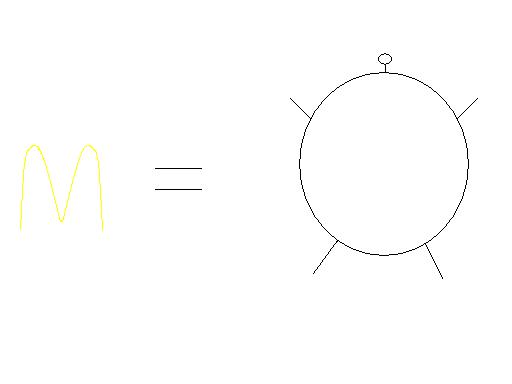
McDonald's to offer more nutrition information on wrapper...

In an attempt to help them with their new campaign, I've designed a graphic which visually summarizes the information, for the benefit those who are unable to read or otherwise understand it.


7:30 am update: Is this good fun, or just plain mean? What do you think? Feel free to leave comments.

Wednesday, October 26, 2005

This Just In--The Spirit of Spurgeon Speaks

Breaking news...

Responding to the question of what he really believed about the doctrine of substitutionary atonement, the spirit of Spurgeon is said to have replied:

"The doctrine of Holy Scripture is this, that inasmuch as man could not keep God's law, having fallen in Adam, Christ came and fulfilled the law on the behalf of his people; and that inasmuch as man had already broken the divine law and incurred the penalty of the wrath of God, Christ came and suffered in the room, place, and stead of his elect ones, that so by his enduring the full vials of wrath, they might be emptied out and not a drop might ever fall upon the heads of his blood-bought people."


Read the full transcript here.

Now Here's Something You Don't See Every Day!

And you probably wouldn't care if you did.

But I almost had a heart attack yesterday at work when I pulled up the ESV Bible Blog and the current entry started with my name.

Monday, October 24, 2005

An Unsolicited Link-Digital Puritan

Want to give a big shout-out to the Digital Puritan, who (to the best of my knowledge) has never commented on my blog, yet I found out he has me on his blogroll. (HT to Blogshares--they really are good for something).

He doesn't have a lot of posts, but there is a definite focus on quality. Also, he's recently given the site a makeover. Looks outstanding! (I wonder if he freelances for those who are too busy & inept to change their default template...)

Saturday, October 22, 2005

Weekly Wrapup

Here are some blog highlights from this week. Kind of like Blogspotting, only not as cool. And definitely not as cool as Blogwatching.

The guys over at TMS Alumni wonder if the new Chronicles of Narnia movies is just another way of exploiting the church for cash. I'll admit, I've been wondering the same thing.

Carla Rolfe has an interesting post on Halloween. She tells about the different extremes she has gone through during the course of her life, and how her family handles it now. She ends by saying that we shouldn't judge others salvation based on whether they agree with us about trick-or-treating. I say, "Amen to that!" BTW, her blog is filled with some of the most beatiful pictures on the web.

Tim Challies also talks about "the inevitable Halloween discussion." Frankly, I think I'd rather talk about Petra.

Adrian Warnock does research about what Bible translations are used by bloggers. He finds the results interesting. Given his methodology, I question some of his conclusions (as did others in the comments section). Nevertheless, I will state categorically that the ESV is by far the easiest translation to use for the internet & blogging. One of my favorite reasons for using it on the blog is the Firefox search box extension. (The ESV blog also has info on Wordpress Plugins, and a cool javascript thingamajig that gives you popups for webpages). Warnock also surprises everyone, including apparently himself, by quoting the NLT.

Al Mohler talks about the scandal of Biblical illiteracy. It's as scandalous in 2005 as it was in September 2003, when he originally posted it. This is one of the reasons for my comments about the 100 Minute Bible--the need is out there, even if their proposed solution is flawed.

The Black Calvinist, Kerry Gilliard, makes a rather straightforward statement about the Roman Catholic church's rejection of Biblical authority (specifically the idea of justification by faith alone) that turns into a full-blown discussion. (I had to jump in--near the bottom of comments, if you care).

Centuri0n has some great posts this week, but I think my favorite thing of all he wrote was this comment on another blog: "I'm completely spent writing, btw. Trying to keep up with Doug Wilson has been like taking a joy ride with Lance Armstrong one random saturday." I can't even keep up with reading those two (much less writing...). I keep wondering if he's gonna delink me (or worse--move me down to the Num 22:9 section) after a couple of comments I've made. On the plus side, I did ask for an instant replay on his alleged yellow-flag penalty. Still, here's hoping he really doesn't have a three strikes rule.

Hemsch wonders about the message in Sci-Fi, specifically, why do heroes who aren't Christians have moral values? He and I share a passion for the stuff (Thomas Watson would call this our "besetting sin"). I've been trying to write a response, but both the topic and the genre are so big, it's hard to know where to begin. As an opening volley, I'll just say that all forms of non-Christian belief believe there is some goodness in man (how it manifests itself varies). This is not unique to Sci-Fi at all. What is unique about Sci-Fi is its ability transport us and force us to think about things that, if they were presented in their current context, we might never consider. This is Sci-Fi at its best (and worst). I hope to write a post soon about the worldview of Star Wars, where I will probably cover this topic at greater length.

Oh, and Phil Johnson is back.

Thursday, October 20, 2005

William Dicks--thanks for stopping by!

William Dicks stopped by my blog today, to leave me a note updating my Phil Johnson Blog Star post. He invited me to stop by his blog, which I did.

Wow!

But don't take my word for it. Check out this post about the Reformation. Very timely, given the upcoming Reformation Day (Oct. 31), and also the current church climate where everyone seems eager to undo all the gains that took place as a result of the Reformation.

Now--regarding the Reformation, the online Catholic Encyclopedia has this to say:
The Reformation destroyed the unity of faith and ecclesiastical organization of the Christian peoples of Europe, cut many millions off from the true Catholic Church, and robbed them of the greatest portion of the salutary means for the cultivation and maintenance of the supernatural life. Incalculable harm was thereby wrought from the religious standpoint.
What a sad blindness to the truth! The Reformation resulted in the recovery of the Doctrines of Grace, not incalculable harm. True, it cut many off from the Catholic Church; but it brought them instead into the true catholic church: not the Pope's church, or Mary's church, but Christ's church.

Anyway, thanks to Bill for stopping by. Hope you'll come visit again soon. I'll definitely be heading over to your blog again in the near future.